Real businesses.
Real results.
These aren't edge cases. Every company on this page came to us with the same problem — too many tools, too little visibility, jobs falling through the cracks. Here's what happened after they switched to CommonThread.
Peter Norman


Code3AV installs commercial AV systems for government agencies, universities, and corporations — complex 90-day projects with equipment, crews, multiple job sites, and client sign-off before a single invoice goes out. As they scaled from 12 people to 30, with 35 active projects running at any time, their patchwork of Excel spreadsheets, Outlook, and shared drives hit a wall. They tried every purpose-built AV platform they could find. They tried Salesforce. They tried monday.com. Every time, the same result.
"We spent tens of thousands of dollars on other systems that just did not pull it off for us sufficiently. We'd get all the licensing done, they'd make all these promises up front — and then we'd get to the point where we really actually need it to work, and it just didn't."
By the time Peter found CommonThread, he was gun-shy. Three or four failed implementations had cost real money and real time. Then he saw the first demo — and it looked better than what other vendors had delivered after months of paid work. The differentiator wasn't just the software: it was that IdeaWeavers understood both the business and the industry.
"CommonThread feels really purpose-built for service businesses by people who really understand business. Some of these other systems maybe understood business, or maybe they understood the industry — but none of them really seemed to understand both."
Jobs now run on rails. Field crews have everything they need before they arrive on site. Systems are built and tested before leaving the shop. Every handoff between departments is smoother and more consistent — because the software drives the process now, not any one person. Project closeout is cleaner, documentation is ready at go-live, and Code3AV is getting paid faster as a result. Management meetings dropped from 90 minutes to 30.
"The software is pulling us through the process now, instead of any one person trying to drive the process. It's less easy to just get around it and take shortcuts now."
Mark Helberg
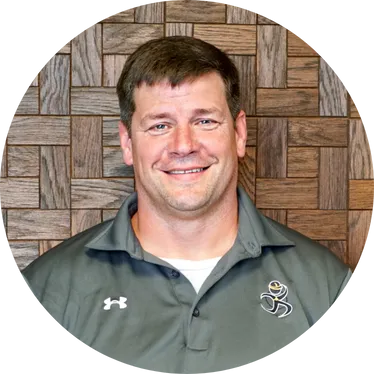
First Call responds to hazardous spills and environmental emergencies. As the company grew to 98 calls a week, field crews ran on paper notebooks. Documents got touched 10–15 times before a job closed. Management had no way to know which jobs needed attention without manually reviewing all of them. They tried an off-the-shelf platform. It did 70% of what they needed — and forced them to adapt to it for the rest.
"The nature of the work we do is a little unique. Everybody has their own processes and procedures. We wanted a system that worked with those — an off-the-shelf system just couldn't do that for us."
CommonThread replaced paper field notebooks with electronic ones — data captured on scene flows directly into the system, no re-entry, no two hours of catch-up paperwork at the end of a 12-hour shift. Instead of Friday reports, management now has live dashboards and "job temperatures" — a flag that surfaces the two jobs out of 98 that need attention right now.
A platform that started as project management software and grew into the operating system for the entire company — field crews, project management, sales, finance, and customer records, all in one place.
"When the guys in the field that initially didn't want to change come back with 'hey, I see other ways it can help me be more efficient' — that really speaks to the value of having that software in the hands of the guys on the very front line."
Jesse Whitacre

Jesse was running Moxie Movers on notebooks and handshakes. Employees would dispute their pay — no records to prove it either way, so he'd just pay up. Customers would call the night before a move that had never been confirmed in the system. He'd scramble to staff up last minute, pulling people from home.
"I'd say, I don't know what you're talking about. We never booked this. But at that point, I can't tell somebody we're not coming."
CommonThread digitized Moxie's paper processes without asking the movers to change how they thought. Bookings got confirmations and reminders. Pay got tracked. Terminology matched Moxie's own language — no jargon, no relearning.
"The user in the field didn't have to change their thought process. It was more just taking an action they were reading on paper and transferring it to a button they would push. Pretty seamless transition."
Moxie went from 2 trucks to 8. Jesse nailed down the loose ends and freed himself up to focus on growth. Now the business runs without him.
"We went from running two trucks to eight trucks and the thing just runs itself. I have all those things now — the time, the money, the freedom."
Monte Morgan

NOVA Tastings pairs brand ambassadors with major beverage retailers for live sampling events. As they grew, the backend hit a ceiling. Scheduling was done across scattered Google Sheets and Post-it notes. Staff raced to claim shifts online, locking out local talent. Leadership was working 60–100 hours a week just to handle administrative re-work.
"Before the system — 60 to 80 hours a week. 100 hours was not uncommon. And we were missing stuff, stuff was getting lost."
IdeaWeavers deployed CommonThread built around NOVA's real-world field environment — an automated scheduling engine that matches open shifts to personnel by proximity, availability, and product certifications. Brand ambassadors manage their entire shift via mobile. Managers get live dashboards. Clients get a portal showing real-time event data.
"With mass-marketed systems, you have to adapt to that system. Whereas with this you didn't. They adapted to what we were doing and helped us build the process."
Scheduling dropped from 2–3 hours to 25 minutes per program. Client recap reports went from 3 hours to 15 minutes. NOVA doubled their weekly shift capacity and is actively launching in new states.
"There's no reason why we can't grow to 400 shifts a week quickly. Because the system's there and it can handle it. Could you have grown without this software? You could — but you'd be working 24 hours a day. That's not a way to run a business."
Want to be the next success story?
Start with a free 30-minute Workflow Audit. We'll map your current operation and show you exactly what CommonThread would look like for your business.
Book your free Workflow AuditLet's talk about your operation.
Whether you're ready to book a Workflow Audit or just have a question — we're a real team and we respond fast. No bots, no sales queue.